Part of our Neotonics overview. Label and evidence checked October 19, 2026.
The Neotonics ingredients list is short and printed in full on the vendor's own label. What the label leaves out is the dose of every plant in its 430 mg blend. Below we go through each item, what the research on it actually covers, and where the safety questions sit.
What are the Neotonics ingredients?
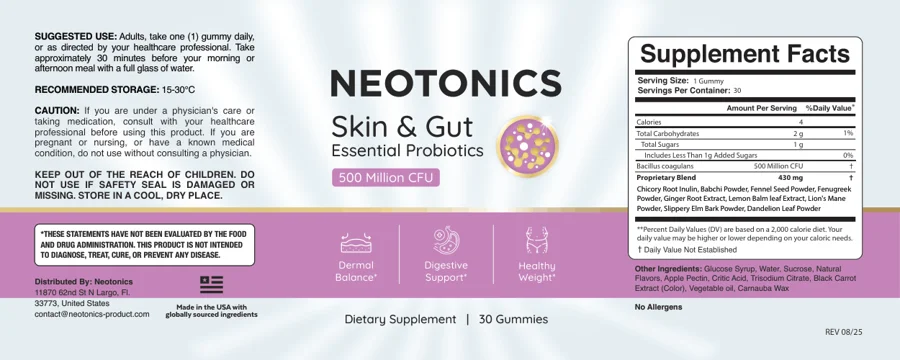
One gummy contains Bacillus coagulans at 500 million CFU plus a 430 mg proprietary blend of chicory root inulin, babchi powder, fennel seed, fenugreek, ginger root extract, lemon balm leaf extract, lion's mane, slippery elm bark and dandelion leaf.[1]
The gummy also has 4 calories, 2 g of carbohydrate and 1 g of sugar. Its other ingredients are glucose syrup, water, sucrose, natural flavors, apple pectin, citric acid, trisodium citrate, black carrot extract for color, vegetable oil and carnauba wax. The label says "No Allergens".[1]
What does each Neotonics ingredient do, according to research?
The grades rate the human research behind each ingredient for any use, not Neotonics itself. Nobody has run a trial on the product. "Skin" means oral human evidence for wrinkles or skin aging.
| Ingredient | Amount | Best human evidence | Skin evidence | Grade |
|---|---|---|---|---|
| Bacillus coagulans | 500 million CFU | IBS symptoms, named strains at about 2 billion CFU[9] | Topical metabolite cream only[11] | Limited |
| Chicory root inulin | Hidden | Blood sugar and cholesterol in diabetes; no weight effect[12] | None found | Weak |
| Babchi powder | Hidden | Traditional vitiligo use with sunlight | Topical bakuchiol only[4] | Avoid orally |
| Fennel seed | Hidden | Period pain, small biased trials[13] | None found | Limited |
| Fenugreek | Hidden | Not enough evidence for diabetes, per NCCIH[15] | None found | Weak |
| Ginger root extract | Hidden | Small weight signal in overweight adults[16] | None found | Limited |
| Lemon balm leaf extract | Hidden | Sleep, at 300 to 1,200 mg a day[18] | Topical cold sore cream only | Limited |
| Lion's mane | Hidden | Mild memory decline, at 1.8 to 3 g a day[19] | None found | Limited |
| Slippery elm bark | Hidden | Only uncontrolled multi-herb studies[21] | None found | Weak |
| Dandelion leaf | Hidden | One 17-person study, no placebo[23] | None found | Weak |
How much of each plant is in a Neotonics gummy?
The label does not say. All nine plants share one 430 mg line, so if they were split evenly each would get about 48 mg.[1]
The real split may be uneven, and the label gives no way to tell. Even the even-split figure sits far below the studied amounts. Lion's mane trials used 1.8 to 3 g a day,[19][20] lemon balm studies used 300 to 1,200 mg of extract,[18] and inulin trials dose in grams.[12] A 430 mg blend shared nine ways has no room for those amounts.
Our main site covers the memory data in more depth in lion's mane for memory.
Is the Neotonics probiotic strong enough?
It is on the low side. Neotonics gives 500 million CFU of Bacillus coagulans and does not name a strain, while the gut trials used named strains at about 2 billion CFU a day.[1][9]
A 36-person trial gave strain MTCC 5856 at 2 billion CFU a day for 90 days to people with diarrhea-type IBS and saw less bloating and pain than placebo.[9] A 136-person trial of strain Unique IS2 also improved IBS pain.[10] Both were small and funded by the strain makers.
NCCIH notes that probiotic effects depend on the strain, so results from one strain cannot be assumed for another.[24] Our main site explains the wider picture in do probiotics work.
Why is babchi the ingredient to watch?
Babchi seed (Psoralea corylifolia) contains psoralens, which make skin more sensitive to sunlight, and it has been linked to case reports of liver injury.[5][8]
A 2009 report described three cases of acute hepatitis after Fructus Psoraleae products and called it "one of the emerging hepatotoxins".[5] A UK patient developed hepatitis after taking the seeds for vitiligo and recovered after stopping.[6] A 2019 report described a woman who died of liver failure after about 7 months of tablets containing it.[7] These are case reports, so they cannot tell us how often harm happens, and Neotonics' babchi dose is unknown.
The skin research the vendor leans on is about bakuchiol, a compound from the seed, applied as a 0.5% cream. In 44 people it matched retinol for wrinkles over 12 weeks.[4] No trial shows that swallowing babchi does the same. Our Neotonics side effects page covers who should skip it.
Does the sales page match the label?
Mostly. The nine plants and the probiotic match, but the sales page calls the ginger and lion's mane "Organic" and the label does not.[1][2]
The sales page also gives each plant a skin job. It says babchi "Supports collagen production", lemon balm "Tightens skin" and fennel "Repairs body tissues".[2] We found no human research behind those claims at any dose. The vendor's FAQ says it is made in an "FDA-approved facility". FDA does not approve supplements or the facilities that make them.[3] If a page shows an "FDA Approved" badge, trust the label on the bottle you receive.
Which other Neotonics ingredients matter?
Fennel, fenugreek, dandelion and slippery elm each have a caution worth knowing, even at small doses.
Fennel contains estragole, which studies flag for regular long-term use.[14] Fenugreek can cause diarrhea and nausea, may lower blood sugar at large doses and is not considered safe in pregnancy above food amounts.[15] NCCIH says there is "no compelling scientific evidence" for dandelion in any condition and notes possible allergy in people sensitive to ragweed.[22] Slippery elm forms a gel in the gut and may slow absorption of other medicines.[21] For whether the whole formula adds up, see does Neotonics work, and for timing, see how to take Neotonics.
Back to the Neotonics overview.
Frequently asked questions
What are the main ingredients in Neotonics?
Neotonics contains Bacillus coagulans at 500 million CFU and a 430 mg blend of chicory root inulin, babchi, fennel, fenugreek, ginger, lemon balm, lion's mane, slippery elm and dandelion. The gummy base is glucose syrup, sucrose and apple pectin.
Does Neotonics contain collagen or hyaluronic acid?
No. Neither collagen nor hyaluronic acid appears on the Neotonics label. The only skin-linked item is babchi, and its skin data come from bakuchiol applied as a cream, not from swallowing the seed powder.
Is Neotonics a proprietary blend?
Yes, for the plants. All nine plant items share one 430 mg line with no individual amounts, which averages about 48 mg each. Only the probiotic count, 500 million CFU of Bacillus coagulans, is stated on its own.
Which Neotonics ingredient carries the most risk?
Babchi. Its seeds contain psoralens that raise sun sensitivity, and case reports link babchi products to liver injury, including one death after months of use. The amount in Neotonics is not disclosed, so the risk at this dose is unknown.
Are the Neotonics ingredients organic?
The sales page calls the ginger and lion's mane organic, but the Supplement Facts label does not say organic for any ingredient. Go by the label on the bottle you receive, not the sales copy.
Sources
- Neotonics references page and Supplement Facts label. Neotonics (vendor), label REV 08/25 (read October 19, 2026).
- Neotonics text presentation. Neotonics (vendor), undated (read October 19, 2026).
- Neotonics contact and FAQ. Neotonics (vendor), undated (read October 19, 2026).
- Dhaliwal: bakuchiol vs retinol cream. PubMed, 2019 (read October 19, 2026).
- Cheung: hepatitis after Fructus Psoraleae. PubMed, 2009 (read October 19, 2026).
- Smith: acute hepatitis from babchi seeds. PubMed, 2014 (read October 19, 2026).
- Li: fatal liver failure with Fructus Psoraleae tablets. PubMed, 2019 (read October 19, 2026).
- Phototoxic reaction to Psoralea seeds in a child. PubMed abstract (read October 19, 2026).
- Majeed: Bacillus coagulans MTCC 5856 in IBS. PubMed, 2016 (read October 19, 2026).
- Madempudi: Bacillus coagulans Unique IS2 in IBS. PubMed, 2019 (read October 19, 2026).
- Topical LactoSporin cream and wrinkles. PubMed abstract (read October 19, 2026).
- Inulin-type fructans, meta-analysis of 33 trials. PubMed abstract (read October 19, 2026).
- Lee: fennel for period pain, meta-analysis. PubMed, 2020 (read October 19, 2026).
- Estragole in fennel preparations. PubMed abstract (read October 19, 2026).
- Fenugreek. NCCIH (read October 19, 2026).
- Maharlouei: ginger and body weight, meta-analysis. PubMed, 2019 (read October 19, 2026).
- Lemon balm phytosome and insomnia. PubMed, 2024 (read October 19, 2026).
- Mori: lion's mane in mild cognitive impairment. PubMed, 2009 (read October 19, 2026).
- Docherty: lion's mane in healthy adults. PubMed, 2023 (read October 19, 2026).
- Hawrelak: herbal formulas with slippery elm in IBS. PubMed, 2010 (read October 19, 2026).
- Dandelion. NCCIH, archived copy (read October 19, 2026).
- Clare: dandelion leaf and urination. PubMed, 2009 (read October 19, 2026).
- Probiotics: What You Need To Know. NCCIH (read October 19, 2026).
This page is general information, not medical advice. Dietary supplements are not reviewed by the FDA for safety or effectiveness before they are sold and are not intended to diagnose, treat, cure or prevent any disease. Talk to your doctor before taking any supplement, especially if you are pregnant, nursing, take medication or have a health condition.